Grocery Store Shrinkage: A Complete Guide to Preventing Wastage, Pilferage and Inventory Loss

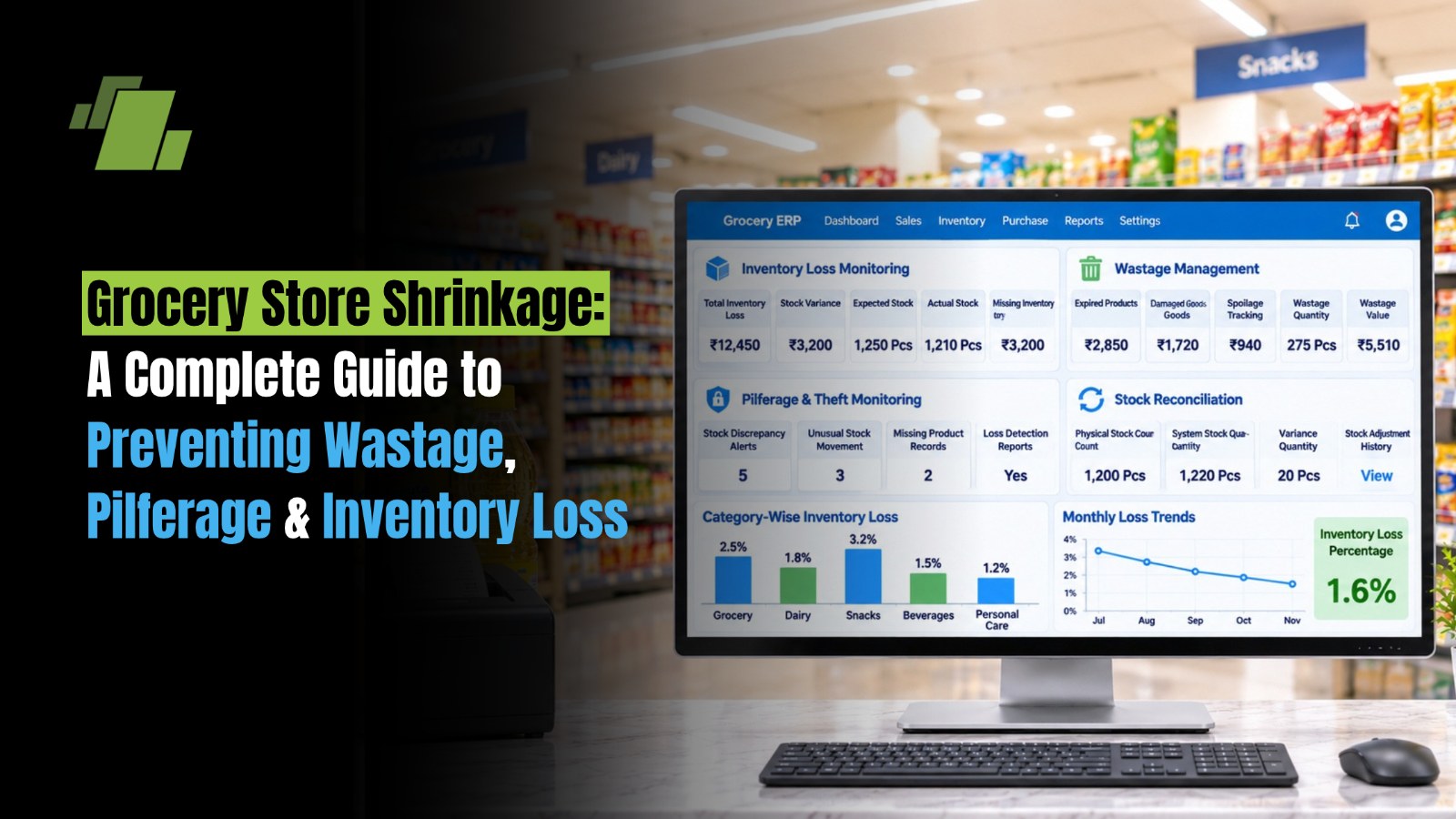
Grocery store shrinkage is one of the most overlooked causes of declining retail profitability. Products disappearing from shelves, expired food items, damaged packaging, incorrect stock entries, supplier shortages and employee pilferage can gradually reduce a store's margins without being immediately visible in daily sales reports.
For grocery retailers operating supermarkets, kirana stores and multi-outlet grocery chains, controlling inventory loss requires more than conducting occasional physical stock audits. It involves monitoring every stage of inventory movement, from procurement and goods receipt to storage, shelf replenishment, billing, returns and stock adjustments.
A structured inventory control process, supported by grocery software, helps retailers identify where losses occur, investigate discrepancies and take corrective action before they affect profitability.
This guide explains the causes of grocery store shrinkage, how to calculate inventory loss, practical prevention strategies, important monitoring metrics and how technology such as LOGIC ERP can help improve grocery inventory control.
Contact Us
Free Demo Request
What is Grocery Store Shrinkage?
Grocery store shrinkage refers to the reduction in inventory value or quantity when the actual physical stock available in a store is lower than the inventory recorded in its books or management system.
It can result from theft, pilferage, spoilage, expiry, damaged products, supplier shortages, billing mistakes, unrecorded wastage and inventory handling errors.
For example, if a supermarket's inventory system shows 500 packets of a particular product but a physical count finds only 470 saleable packets, the 30-unit difference needs investigation. Some units may have expired, been damaged, sold without proper billing or gone missing.
Not every loss has the same cause. Retailers should distinguish between known inventory loss, such as recorded expiry and damage, and unexplained shrinkage, where the physical stock does not match the system balance.
This distinction is important because each type requires a different corrective action.
Why is Grocery Store Shrinkage a Serious Profitability Problem?
Grocery businesses generally manage a large number of SKUs, frequent replenishment cycles and products with different shelf lives. These operating conditions make inventory control particularly challenging.
A store may sell hundreds of products every day, including fresh produce, dairy, packaged foods, beverages, personal care products and household essentials. Each category has different storage requirements, demand patterns and expiry risks.
When inventory losses are not recorded and investigated properly, retailers face several business problems:
-
Reduced Gross Margins: Every lost or unsaleable product represents an inventory cost that cannot be recovered through normal sales.
-
Incorrect Stock Availability: System stock may show products as available even when the physical quantity is missing.
-
Unnecessary Procurement: Retailers may reorder products that are already available but misplaced or incorrectly recorded.
-
Stockouts: Unidentified inventory discrepancies can prevent timely replenishment of fast-moving products.
-
Increased Wastage: Poor demand planning and stock rotation can cause food products to expire before they are sold.
-
Inaccurate Financial Reporting: Unrecorded losses distort inventory valuation and profitability calculations.
-
Operational Inefficiency: Employees spend additional time investigating discrepancies, recounting stock and correcting records.
For multi-store grocery retailers, these problems become more difficult to control because inventory is distributed across several locations.
What are the Main Causes of Grocery Store Shrinkage?
Grocery store inventory shrinkage can occur at different stages of the retail supply chain. Identifying the source of each loss is the first step towards reducing it.
1. Product Spoilage and Expiry
Product spoilage is a major source of inventory loss in grocery retail, particularly in categories with limited shelf life.
Fresh fruits, vegetables, dairy products, bakery items, frozen foods and packaged foods can become unsaleable when they are stored incorrectly or remain in inventory beyond their expiry dates.
Common reasons include:
-
Excessive purchasing beyond actual customer demand.
-
Improper temperature and storage conditions.
-
Failure to follow First Expiry First Out (FEFO) practices.
-
Poor monitoring of near-expiry products.
-
Inadequate coordination between procurement and sales teams.
-
Delayed removal of expired products from shelves.
How to prevent it:
-
Monitor batch numbers, manufacturing dates and expiry dates.
-
Follow FEFO for products with different expiry dates.
-
Conduct regular shelf-life inspections.
-
Use demand forecasting to avoid overstocking perishable products.
-
Maintain appropriate storage conditions.
-
Identify near-expiry products for permitted promotional markdowns or timely vendor returns.
Grocery inventory management software with batch-wise and expiry-wise tracking can help retailers identify products approaching their expiry dates and take action before they become unsaleable.
2. Employee Pilferage and Internal Theft
Employee pilferage occurs when store personnel deliberately remove products or manipulate inventory records for personal benefit.
It can happen in stockrooms, receiving areas, sales floors, billing counters and warehouse operations.
Examples include:
-
Removing products without generating sales transactions.
-
Recording products as damaged or expired when they are not.
-
Manipulating stock adjustment entries.
-
Processing unauthorised discounts or refunds.
-
Taking products from damaged-goods or returns sections.
-
Transferring inventory without proper documentation.
How to prevent it:
-
Assign role-based access permissions to employees.
-
Restrict stock adjustments to authorised personnel.
-
Require approval for high-value inventory write-offs.
-
Monitor unusual discount, refund and void transactions.
-
Maintain records of all inventory transfers.
-
Conduct surprise physical stock checks.
-
Review employee-wise transaction exception reports.
A well-configured supermarket POS and inventory management system creates transaction-level visibility and makes unusual inventory movements easier to investigate.
3. Shoplifting and External Theft
External theft occurs when customers or visitors remove merchandise without paying for it.
Small, high-demand products, packaged foods, chocolates, personal care products and premium grocery items may be vulnerable to shoplifting.
Common warning signs include:
-
Repeated discrepancies in specific product categories.
-
Missing products from high-traffic display areas.
-
Open or empty product packaging.
-
Unexplained differences between sales and physical stock.
-
Frequent inventory losses involving selected SKUs.
How to prevent it:
-
Install CCTV cameras in suitable areas.
-
Improve visibility across aisles and display shelves.
-
Place high-risk products in monitored locations.
-
Conduct regular inventory checks for frequently targeted SKUs.
-
Train employees to identify suspicious activity without confronting customers unnecessarily.
-
Review store-level shrinkage reports to identify recurring patterns.
Retailers should combine physical security measures with inventory monitoring rather than relying exclusively on CCTV.
4. Supplier Shortages and Receiving Errors
Inventory losses can begin before products even reach the sales floor.
A supplier may invoice 100 units while delivering only 95. Alternatively, products may arrive with damaged packaging, incorrect quantities, missing items or a shorter remaining shelf life than expected.
If the store records the full invoice quantity without verifying the physical delivery, inventory records become inaccurate from the beginning.
How to prevent it:
-
Match purchase orders with supplier invoices and actual deliveries.
-
Verify product quantities during goods receipt.
-
Check packaging condition and expiry dates.
-
Record shortages and damaged quantities separately.
-
Document supplier discrepancies for claims and settlement.
-
Restrict inventory posting until receiving verification is completed.
A structured goods receipt process supported by ERP software helps maintain accurate purchase and inventory records.
5. Incorrect Billing and POS Transaction Errors
Billing errors can create discrepancies between the products physically leaving the store and the transactions recorded in the system.
Common examples include:
-
Scanning an incorrect barcode.
-
Billing a lower-priced product instead of the actual item.
-
Missing product scans.
-
Incorrect quantity entries.
-
Unauthorised price overrides.
-
Processing refunds without properly recording returned stock.
These errors can lead to revenue leakage and incorrect inventory balances.
How to prevent it:
-
Use barcode-based billing.
-
Maintain accurate product and barcode masters.
-
Restrict manual price changes.
-
Monitor voids, refunds and transaction cancellations.
-
Train cashiers to verify quantities and product descriptions.
-
Reconcile POS sales with inventory deductions.
Supermarket billing software integrated with inventory management helps ensure that every completed sale updates the corresponding stock balance.
6. Improper Storage and Product Handling
Poor storage practices can result in damaged, contaminated or unsaleable grocery products.
For example, stacking heavy cartons over delicate packaged products may damage their packaging. Improper refrigeration can affect dairy and frozen food quality, while incorrect handling can accelerate spoilage of fresh produce.
How to prevent it:
-
Define storage guidelines for each product category.
-
Maintain separate storage zones for different temperature requirements.
-
Use appropriate racks, bins and shelves.
-
Train employees in product handling.
-
Record damaged goods immediately.
-
Inspect stock during receiving, put-away and shelf replenishment.
7. Unrecorded Returns, Transfers and Stock Adjustments
Inventory may also become inaccurate when products move between departments, warehouses or store locations without proper documentation.
For example, if 20 units are transferred from a warehouse to a supermarket but the receiving store does not confirm the quantity, the system may show incorrect balances at both locations.
Similarly, returned products must be classified correctly as saleable, damaged or unsuitable for resale.
How to prevent it:
-
Record every stock transfer.
-
Confirm quantities at both dispatch and receipt.
-
Use standard return reason codes.
-
Separate saleable and unsaleable returned goods.
-
Require approval for inventory adjustments.
-
Reconcile pending transfers regularly.
How to Calculate Grocery Store Shrinkage?
Grocery retailers can calculate shrinkage by comparing the expected inventory value with the actual physical inventory value.
The basic formula is:
Shrinkage Value = Recorded Inventory Value - Actual Inventory Value
What is the Difference Between Known and Unknown Shrinkage?
|
Parameter |
Known Shrinkage |
Unknown Shrinkage |
|
Meaning |
Inventory loss recorded with a reason |
Inventory loss discovered during reconciliation |
|
Examples |
Expiry, spoilage, recorded damage |
Missing stock, unrecorded theft, transaction errors |
|
Identification |
Damage and expiry reports |
Physical stock audits |
|
Corrective action |
Better handling, forecasting and stock rotation |
Investigation, process controls and security |
|
Monitoring |
Wastage and write-off reports |
Stock variance and adjustment reports |
Separating these categories helps retailers understand whether inventory loss is primarily operational or caused by unexplained discrepancies.
12 Effective Strategies to Prevent Grocery Store Shrinkage
Reducing grocery store shrinkage requires a combination of inventory discipline, employee accountability, purchasing controls, store security and technology.
The following strategies can help grocery retailers build a more reliable inventory control process.
1. Implement FEFO and FIFO Inventory Rotation
FIFO (First In, First Out) ensures that older inventory is sold before newer inventory.
FEFO (First Expiry, First Out) prioritises products with the earliest expiry dates, irrespective of when they were received.
For grocery stores, FEFO is particularly important because two batches of the same product may have different expiry dates.
For example, if a supermarket receives two batches of packaged dairy products, one expiring on 10 December and another on 20 December, the batch expiring on 10 December should be prioritised for sale.
Retailers should:
-
Arrange products according to expiry dates.
-
Label batches clearly.
-
Monitor near-expiry inventory.
-
Train shelf replenishment staff.
-
Avoid placing newer stock in front of older products.
2. Conduct Regular Physical Stock Audits
Physical stock audits help identify differences between actual inventory and system records.
Instead of depending entirely on annual stock verification, grocery retailers should conduct smaller, more frequent inventory checks.
A practical approach includes:
-
Daily checks for high-risk and fast-moving products.
-
Weekly checks for selected product categories.
-
Monthly category-wise stock verification.
-
Periodic complete physical inventory audits.
Cycle counting is particularly useful because retailers can verify selected SKUs without stopping the entire store operation.
For example, a supermarket can count high-value personal care products on Monday, packaged food on Tuesday and beverages on Wednesday.
The frequency should depend on stock value, sales velocity, shrinkage history and operational risk.
3. Strengthen Goods Receiving and Purchase Verification
Every incoming delivery should be verified before the inventory is accepted into the system.
A proper receiving process should include:
-
Match the purchase order with the supplier invoice.
-
Count the physically delivered quantity.
-
Check product condition and packaging.
-
Verify batch numbers and expiry dates.
-
Record shortages and excess quantities.
-
Document damaged products separately.
-
Approve and post the verified goods receipt.
This process prevents supplier discrepancies from becoming permanent inventory inaccuracies.
4. Monitor Near-Expiry and Slow-Moving Products
Unsold inventory ties up working capital and increases the possibility of expiry-related losses.
Retailers should regularly identify products with low sales velocity and limited remaining shelf life.
For example, a supermarket may discover that certain packaged food products are selling slowly despite having sufficient stock.
It can respond by:
-
Reducing future purchase quantities.
-
Introducing permitted promotional offers.
-
Improving product placement.
-
Coordinating vendor returns where applicable.
-
Adjusting replenishment based on actual demand.
A near-expiry inventory report helps managers identify products requiring immediate attention.
5. Set Category-Wise Inventory Controls
Different grocery categories require different inventory management strategies.
|
Grocery Category |
Major Shrinkage Risk |
Recommended Control |
|
Fruits and vegetables |
Spoilage and handling damage |
Daily quality checks and demand-based purchasing |
|
Dairy products |
Expiry and temperature-related spoilage |
FEFO and temperature monitoring |
|
Packaged foods |
Expiry and packaging damage |
Batch-wise inventory tracking |
|
Beverages |
Breakage and handling losses |
Safe storage and physical verification |
|
Personal care |
Pilferage and theft |
Access controls and frequent cycle counts |
|
Frozen foods |
Temperature-related spoilage |
Cold-chain monitoring and expiry checks |
|
Bakery products |
Short shelf life and unsold stock |
Daily production and demand planning |
Category-wise controls help store managers address the actual reasons behind product losses instead of applying the same process to every item.
6. Restrict Unauthorised Inventory Adjustments
Manual stock adjustments can hide inventory discrepancies when employees are allowed to modify quantities without proper approval.
Retailers should establish clear approval procedures for:
-
Stock shortages.
-
Damage entries.
-
Expiry write-offs.
-
Inventory transfers.
-
Sales returns.
-
Manual stock corrections.
Every adjustment should include a reason, date, employee identification and approval where required.
7. Analyse POS Exceptions and Refund Transactions
Point-of-sale transactions provide useful information for identifying unusual billing activity.
Store managers should regularly review:
-
Cancelled bills.
-
Post-void transactions.
-
Manual discounts.
-
Price overrides.
-
Refunds and exchanges.
-
Repeated barcode mismatches.
-
Cashier-wise transaction exceptions.
For example, if one cashier consistently records unusually high product cancellations compared with other cashiers, the transactions should be reviewed to understand the reason.
8. Improve Warehouse and Backroom Organisation
Poorly organised storage areas increase the risk of misplaced products, damage and unrecorded stock movement.
Retailers should maintain:
-
Clearly labelled storage locations.
-
Separate areas for saleable and damaged goods.
-
Defined receiving and dispatch zones.
-
Restricted access to high-value products.
-
Documented stock movement procedures.
-
Regular housekeeping and storage inspections.
For larger grocery businesses, warehouse management software (WMS) can support bin-wise inventory tracking, barcode scanning and controlled stock movements.
9. Use Demand Forecasting to Prevent Overstocking
Excess purchasing is a major contributor to expiry and spoilage, particularly in perishable categories.
Retailers should consider historical sales, seasonal variations, promotional demand, local buying patterns and current inventory before generating purchase orders.
For example, a grocery store near a residential area may experience higher demand for beverages and snacks during weekends, while demand for certain products may increase during festivals.
Demand-based replenishment helps retailers maintain product availability without unnecessarily increasing inventory.
10. Introduce Employee Accountability and Training
Inventory control depends on employees following consistent operating procedures.
Retailers should train staff on:
-
Goods receiving and verification.
-
Product handling and storage.
-
FEFO and FIFO practices.
-
Damage and expiry recording.
-
Barcode-based billing.
-
Stock transfers and returns.
-
Physical inventory counting.
Managers should also assign responsibility for specific inventory areas and review performance through periodic audits.
11. Track Inventory Loss Through Regular Reporting
Retailers should not wait until the end of the financial year to understand inventory losses.
Store managers should review shrinkage reports regularly to identify recurring discrepancies.
Useful reports include:
-
Category-wise shrinkage report.
-
SKU-wise stock variance report.
-
Expiry and wastage report.
-
Damaged goods report.
-
Store-wise inventory adjustment report.
-
Supplier-wise receiving discrepancy report.
-
Employee-wise POS exception report.
12. Integrate Inventory, Billing and Accounting Processes
When billing, inventory, purchasing and accounting operate independently, retailers often face delays and inconsistencies in stock reconciliation.
An integrated grocery ERP system connects these business processes.
For example, when a cashier bills a product, the system updates inventory automatically. When damaged goods are recorded, the stock balance and corresponding accounting records can be updated through the configured workflow.
This creates better visibility into stock movement and the financial impact of inventory losses.
How Grocery Inventory Management Software Helps Reduce Shrinkage
Grocery inventory management software helps retailers monitor inventory movement, identify discrepancies and maintain accurate stock records across purchasing, receiving, storage, sales and returns.
An integrated solution such as LOGIC ERP connects grocery inventory management with Retail POS, procurement, warehouse management, accounting and business reporting.
Here is how relevant software capabilities support shrinkage prevention.
1. Batch-Wise and Expiry-Wise Inventory Tracking
Grocery retailers can manage products with different batch numbers, manufacturing dates and expiry dates.
This helps store managers identify near-expiry stock, monitor batch-level inventory and prioritise products requiring attention.
2. Barcode-Based Inventory Management
Barcode-based inventory processes improve accuracy during receiving, stock transfers, physical counting and billing.
Instead of depending entirely on manual quantity entries, employees can scan products to record inventory movements.
3. Integrated Supermarket POS and Inventory Management
LOGIC ERP connects supermarket billing with inventory records.
When a product is sold through the POS counter, the corresponding inventory quantity is updated according to the configured transaction workflow.
This reduces the need for separate manual stock deductions and helps maintain better alignment between sales and available stock.
4. Stock Adjustment and Damage Management
Retailers can record inventory differences, damaged goods and wastage through structured stock adjustment processes.
With appropriate permissions and approval workflows, managers can monitor stock corrections and investigate recurring losses.
5. Warehouse and Multi-Location Inventory Control
Businesses operating multiple stores and warehouses need visibility into inventory movement between locations.
LOGIC ERP supports inventory management across locations, with relevant WMS capabilities such as bin and rack management, barcode scanning and RFID-based processes.
This helps improve stock traceability and control over warehouse operations.
6. Business Insights and Management Reporting
Retail managers need timely information to identify where inventory losses are increasing.
Business Insights and relevant reporting modules can help management analyse:
-
Product-wise stock movement.
-
Category-wise sales performance.
-
Store-wise inventory positions.
-
Inventory adjustments.
-
Slow-moving and non-moving products.
-
Wastage and expiry trends, where recorded.
-
Purchase and sales performance.
The availability of specific reports depends on the configured modules and business workflows.
Grocery Store Shrinkage vs. Inventory Wastage: What is the Difference?
Although the terms are related, inventory shrinkage and inventory wastage are not exactly the same.
|
Parameter |
Inventory Shrinkage |
Inventory Wastage |
|
Meaning |
Reduction in recorded inventory compared with actual stock |
Products lost or rendered unsaleable |
|
Main causes |
Theft, errors, shortages and unrecorded losses |
Expiry, spoilage, breakage and damage |
|
Identification |
Stock reconciliation and audits |
Damage, expiry and wastage recording |
|
Financial impact |
Unexplained or documented inventory loss |
Cost of unsaleable products |
|
Prevention |
Inventory controls, audits and security |
FEFO, storage and demand planning |
Inventory wastage can be a component of total inventory shrinkage when the retailer's shrinkage definition includes documented product losses. However, retailers should maintain separate records for both to understand their actual loss patterns.
Key KPIs to Monitor Grocery Store Shrinkage
Measuring inventory loss is essential for evaluating whether shrinkage prevention measures are working.
Grocery retailers should monitor the following KPIs at SKU, category, store and business levels.
|
KPI |
Calculation / Measurement |
Business Purpose |
|
Inventory Shrinkage % |
Shrinkage value ÷ recorded inventory value × 100 |
Measures inventory loss |
|
Inventory Accuracy % |
Correctly recorded stock ÷ total stock checked × 100 |
Evaluates stock record accuracy |
|
Expiry Loss % |
Expired stock value ÷ inventory value × 100 |
Measures expiry-related losses |
|
Damage Rate |
Damaged stock value ÷ inventory value × 100 |
Tracks product handling losses |
|
Stock Adjustment Value |
Total value of manual stock adjustments |
Identifies inventory corrections |
|
Receiving Discrepancy Rate |
Discrepant received units ÷ expected units × 100 |
Measures supplier delivery accuracy |
|
Return Exception Rate |
Flagged return transactions ÷ total return transactions × 100 |
Identifies unusual return patterns |
Note: Retailers should define consistent measurement periods and valuation methods. For inventory accuracy, the formula should be applied at the SKU or unit level using a clearly defined counting methodology.
How to Identify Products with High Shrinkage?
A useful approach is to create a SKU-wise inventory loss report and rank products according to their shrinkage value and frequency.
For example:
|
Product |
Recorded Stock |
Physical Stock |
Missing Units |
|
Premium Cooking Oil |
100 |
96 |
4 |
|
Packaged Dairy |
150 |
140 |
10 |
|
Chocolate Packs |
200 |
188 |
12 |
|
Personal Care Products |
80 |
78 |
2 |
The supermarket manager can investigate whether these differences are related to expiry, damage, billing errors, receiving discrepancies or theft.
Prioritising products with repeated or high-value discrepancies helps store managers focus their investigation efforts.

Common Grocery Inventory Management Mistakes That Increase Shrinkage
Even grocery retailers with inventory software can experience significant stock losses when their operating processes are inconsistent.
Some common mistakes include:
1. Depending Only on Annual Physical Stock Audits
Annual audits may identify inventory discrepancies too late. Regular cycle counting helps detect problems earlier.
2. Ignoring Near-Expiry Products
Without expiry monitoring, products may remain on shelves until they become unsaleable.
3. Recording all Inventory Differences as General Adjustments
Using generic adjustment entries makes it difficult to identify whether losses are caused by damage, theft, spoilage or operational errors.
4. Allowing Unrestricted POS Access
Uncontrolled refunds, discounts and stock corrections can increase the risk of inventory and revenue leakage.
5. Accepting Supplier Deliveries Without Verification
Recording invoice quantities without physically checking deliveries can create inaccurate inventory records.
6. Maintaining Separate Billing and Inventory Records
Disconnected systems increase manual work and the possibility of incorrect stock balances.
7. Ignoring Store-Wise Shrinkage Trends
A consolidated inventory report may hide the fact that a particular outlet or product category is experiencing repeated losses.
How to Implement a Grocery Store Shrinkage Control Programme
Grocery retailers can introduce a structured shrinkage prevention programme in phases rather than attempting to change every store process simultaneously.
30-Days Grocery Shrinkage Control Plan
-
Week 1: Establish the Inventory Baseline
-
Conduct physical stock verification.
-
Identify high-value and high-risk SKUs.
-
Calculate current shrinkage.
-
Separate known and unexplained losses.
-
Week 2: Strengthen Inventory Processes
-
Introduce FEFO and FIFO procedures.
-
Improve goods receiving verification.
-
Define stock adjustment permissions.
-
Review damaged and expired product handling.
-
Week 3: Improve Monitoring and Accountability
-
Start regular cycle counting.
-
Review POS exceptions and refunds.
-
Assign category-wise responsibilities.
-
Introduce store-level inventory reports.
-
Week 4: Evaluate Performance and Take Corrective Action
-
Compare shrinkage with the initial baseline.
-
Identify recurring discrepancies.
-
Review supplier and employee-related exceptions.
-
Update operating procedures.
At the end of the programme, management should establish recurring reviews and assign responsibility for corrective actions. Shrinkage control should become part of regular store operations rather than a one-time audit activity.
Conclusion: Reduce Grocery Store Shrinkage with Better Inventory Control
Grocery store shrinkage is not caused by a single operational problem. It can result from product spoilage, expiry, pilferage, shoplifting, supplier shortages, incorrect billing, damaged goods and unrecorded inventory movements.
Reducing these losses requires retailers to maintain accurate inventory records, verify incoming deliveries, monitor product shelf life, conduct regular stock audits and establish accountability at every stage of inventory movement.
An integrated grocery ERP solution makes these processes easier to monitor by connecting procurement, inventory, warehouse operations, billing and business reporting.
Struggling with inventory discrepancies, product wastage and unexplained stock losses?
Improve stock visibility, monitor inventory movement and strengthen grocery store operations with LOGIC ERP Grocery Inventory Management Software.
Take control of inventory losses and improve store profitability. Call at +91-73411-41176/75 or send us an email at sales@logicerp.com to book a free demo today!
Frequently Asked Questions
1. What is Grocery Store Shrinkage?
Grocery store shrinkage is the difference between the inventory recorded in a store's management system and the actual physical inventory available. It can result from theft, spoilage, expiry, damage, supplier shortages and transaction errors.
2. What are the Main Causes of Inventory Shrinkage in Grocery Stores?
The main causes include product spoilage, expiry, employee pilferage, shoplifting, supplier delivery shortages, incorrect billing, damaged goods and unrecorded stock transfers or adjustments.
3. How do You Calculate Grocery Store Shrinkage?
Subtract the actual physical inventory value from the recorded inventory value and divide the difference by the recorded inventory value.
Formula: Shrinkage % = (Recorded Inventory Value − Actual Inventory Value) ÷ Recorded Inventory Value × 100.
4. How can Supermarkets Reduce Food Wastage?
Supermarkets can reduce food wastage through demand-based purchasing, FEFO inventory rotation, expiry monitoring, appropriate storage conditions, regular quality inspections and timely action on near-expiry products.
5. What is the Difference Between FIFO and FEFO in Grocery Inventory Management?
FIFO (First In, First Out) prioritises products received earlier, while FEFO (First Expiry, First Out) prioritises products with the earliest expiry dates. FEFO is particularly useful for grocery products with different batch expiry dates.
6. How does Inventory Management Software Help Prevent Grocery Store Shrinkage?
Inventory management software helps track stock movements, monitor batch and expiry details, record damaged products, reconcile inventory discrepancies and generate reports for identifying potential stock losses.
7. How Often Should Grocery Stores Conduct Physical Stock Audits?
Grocery stores should conduct regular cycle counts based on product value, sales velocity and shrinkage risk. High-risk products may require daily or weekly checks, while complete physical stock audits can be scheduled periodically.
8. What is the Difference Between Inventory Shrinkage and Inventory Wastage?
Inventory shrinkage refers to the difference between recorded and actual inventory, while inventory wastage refers to products lost through expiry, spoilage, breakage or damage. Recorded wastage may form part of total shrinkage depending on the retailer's accounting definition.
9. How can Retailers Prevent Employee Pilferage in Supermarkets?
Retailers can reduce employee pilferage through role-based access, authorised stock adjustments, regular inventory audits, POS transaction monitoring, documented stock transfers and employee accountability procedures.
10. What is the Role of Barcode Scanning in Grocery Inventory Control?
Barcode scanning helps improve inventory accuracy during goods receiving, stock transfers, physical counting and billing. It reduces dependence on manual product identification and quantity entry.
11. How can Multi-Store Grocery Chains Monitor Inventory Shrinkage?
Multi-store grocery chains can use centralised inventory management to review store-wise stock balances, inventory adjustments, damaged products, expiry losses and physical stock discrepancies. This helps management identify outlets and categories requiring closer attention.
12. Which Software Features are Important for Grocery Shrinkage Management?
Important features include batch-wise and expiry-wise tracking, barcode scanning, stock adjustment controls, inventory reconciliation, POS integration, warehouse management, stock transfer monitoring and category-wise reporting.

Author
Gurbir Singh
Co-founder & Managing Director | LOGIC ERP Solutions Pvt. Ltd.
With 30+ years of experience in the tech industry, I took the helm of technology & product development, ensuring LOGIC ERP’s continuous innovation & leadership in the evolving tech landscape.

